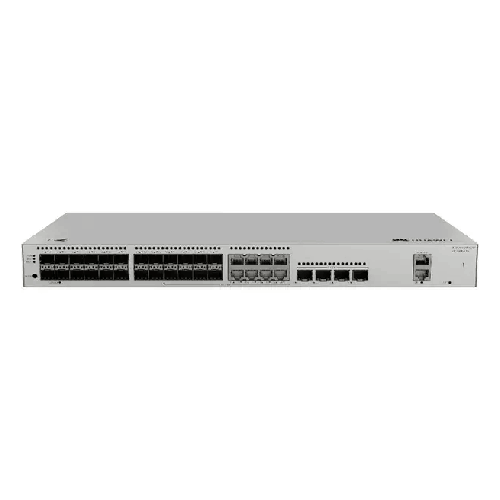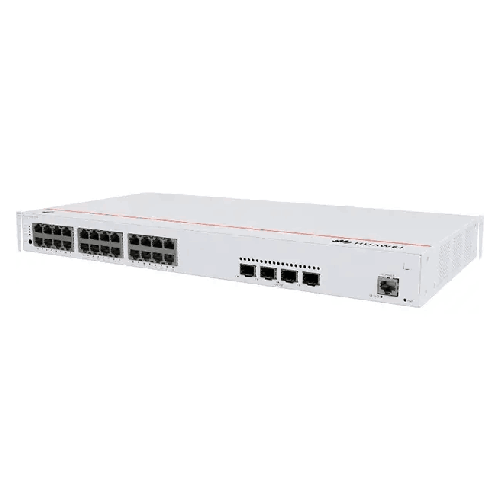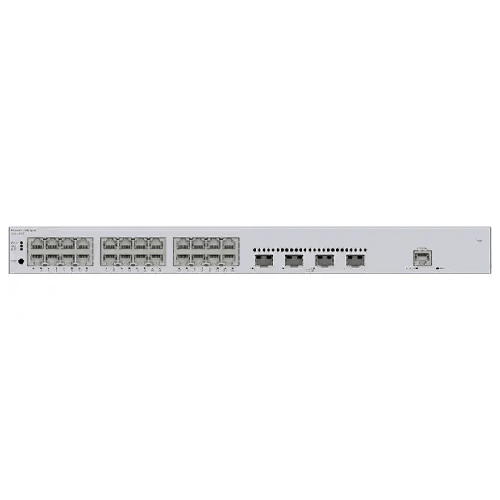

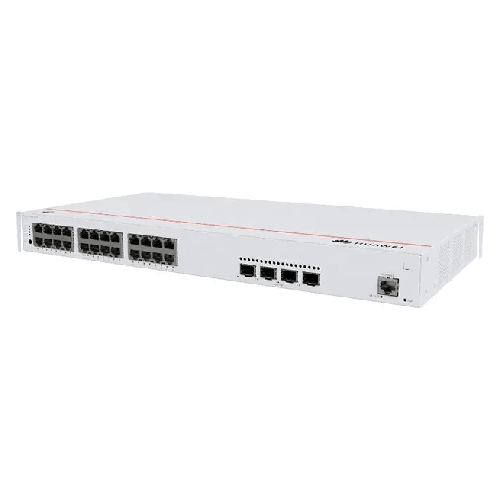
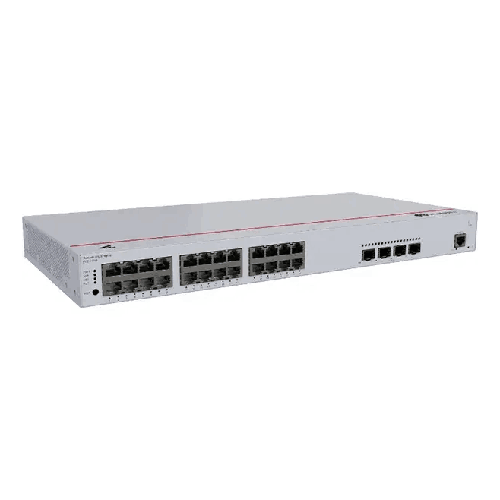
Huawei eKit S310-24P4X Layer 3 Base Managed Gigabit PoE Switch
Regular Price:৳0.00Availability: SKU: 6.54.130.9152
Quick Overview
-
Support
Saturday – Thursday: 09 AM - 06 PM. -
Payment
Cash on Delivery | Card | Online Payment -
Shipping Cost
Inside Dhaka 100tk | Outside Dhaka 150tk -
Warranty Policy
Read More
Description
Huawei eKit S310-24P4X Layer 3 Base Managed Gigabit PoE Switch Price in Bangladesh
The Huawei eKit S310-24P4X Layer 3 Base Managed Gigabit PoE Switch is a professional network switching solution designed for organizations that require managed Gigabit connectivity together with Power over Ethernet capability and high-speed uplink interfaces. With 24 PoE+ Gigabit RJ45 ports supporting 10M/100M/1G connectivity and 4 × 10G/1G SFP+ ports, the switch combines wired network access with the ability to deliver PoE power to compatible network devices.
A major advantage of the Huawei S310-24P4X is its 400W maximum PoE power budget. This allows the switch to serve as both a network connectivity platform and a power source for compatible PoE-powered equipment. Depending on the requirements of the connected devices and the network design, PoE switching can simplify installations by reducing the need for separate power connections at every endpoint.
The S310-24P4X is identified as a Layer 3 Base Managed Gigabit PoE Switch, making it appropriate for structured business and professional network environments where administrators require a managed switching platform rather than a basic unmanaged switch.
24 PoE+ Gigabit RJ45 Ports
The Huawei eKit S310-24P4X provides 24 GE RJ45 ports with PoE+ support, with each port supporting 10M/100M/1G Ethernet connectivity according to the supplied specification.
This port configuration gives organizations a practical combination of wired Ethernet connectivity and PoE capability. Compatible powered devices can receive network connectivity and electrical power through the Ethernet infrastructure, potentially reducing cable complexity at the endpoint.
A 24-port configuration can be useful for offices, commercial facilities, educational environments, surveillance-related network deployments, and other installations where numerous network-connected devices need to be centralized through one switching platform.
The 10M/100M/1G capability also makes the access ports suitable for networks containing devices operating at different Ethernet speeds. Actual connection speed depends on the connected equipment and network conditions.
400W PoE Power Budget
One of the most important specifications of the Huawei S310-24P4X is its 400W maximum PoE power budget. The supplied specification explicitly lists PoE as supported and identifies maximum PoE power consumption as 400W.
A 400W PoE budget provides substantial power capacity for a managed 24-port PoE switching environment. However, the available power should always be planned according to the actual power requirements of the connected PoE devices.
The total PoE budget is shared across the switch's PoE-capable ports. Therefore, installing a large number of high-power devices requires careful power-budget planning to ensure that the combined requirements remain within the switch's available PoE capacity.
This is particularly important in professional deployments where multiple powered endpoints may operate simultaneously.
4 × 10G/1G SFP+ Ports
The switch includes 4 × 10G/1G SFP+ ports.
These high-speed interfaces provide connectivity options for compatible network infrastructure and uplink applications. While the 24 PoE+ RJ45 ports serve connected access devices, the SFP+ interfaces can be used for higher-speed network connections where the infrastructure supports 10G connectivity.
The presence of four SFP+ ports gives network planners additional flexibility when designing an uplink architecture.
The exact optical modules, cables, transmission distances, and supported combinations should be verified against the applicable Huawei compatibility and configuration documentation before deployment.
128 Gbit/s Switching Capacity
The supplied specification lists a 128 Gbit/s switching capacity for the Huawei eKit S310-24P4X.
Switching capacity is an important hardware specification because it represents the internal switching bandwidth available to the device.
In a busy business network, multiple endpoints may transmit and receive data at the same time. A suitable switching architecture helps the switch process traffic across its available interfaces.
The 128 Gbit/s figure should be considered a hardware capability rather than a guarantee that every connected application will continuously achieve a particular real-world throughput. Actual performance depends on network architecture, traffic patterns, connected devices, configuration, and application requirements.
96 Mpps Packet Forwarding Rate
The Huawei S310-24P4X is specified with a 96 Mpps packet forwarding rate.
Packet forwarding rate indicates the switch's ability to process network packets at a high rate. This is another useful specification when evaluating a managed switch for a network containing numerous connected endpoints and simultaneous traffic flows.
Considering packet forwarding rate together with switching capacity provides a broader understanding of the switch's forwarding hardware.
For organizations planning a professional network, these specifications can be compared against the expected workload and network architecture before deployment.
Layer 3 Base Managed Networking
The S310-24P4X is a Layer 3 Base Managed Gigabit PoE Switch, positioning it for managed network environments where administrators require greater control over network infrastructure.
A managed switch can form an important part of a structured business network. Instead of functioning solely as a basic Ethernet connection point, managed networking equipment can be incorporated into a planned architecture where administrators configure, monitor, and maintain network connectivity according to organizational requirements.
The exact Layer 3 features required for a particular deployment should be checked against the applicable Huawei documentation and software version. This is particularly important when the switch is being purchased for a specialized routing, authentication, security, or network-segmentation requirement.
iStack Support
The supplied specification states that iStack supports up to four switches of the same series in a stack.
This capability can be relevant to organizations that expect their network infrastructure to expand beyond one physical switch.
A supported stacking architecture can help organizations plan multiple compatible switches as part of a coordinated network deployment. For growing businesses, this provides another option to consider when designing a network that may require additional switching capacity in the future.
The exact stacking configuration, supported models, software requirements, and deployment procedure should be verified before implementation.
PoE Networking for Connected Devices
Power over Ethernet can simplify network installations because compatible powered devices can receive electrical power through Ethernet infrastructure rather than requiring a separate local power connection.
The Huawei S310-24P4X combines PoE+ access ports with Gigabit networking, making it relevant to deployments where powered network endpoints are part of the infrastructure.
Potential applications can include compatible wireless access points, IP-based devices, surveillance-related equipment, VoIP equipment, and other PoE-compatible endpoints. However, the exact compatibility and power class of every endpoint must be checked before installation.
The switch's 400W PoE budget should also be considered when calculating the total power demand of the proposed deployment.
Metal Chassis
The Huawei S310-24P4X uses a metal chassis.
Professional network equipment is often installed in structured equipment rooms, network cabinets, server areas, offices, or other managed environments. The metal construction forms part of the switch's physical design.
The chassis dimensions are also suitable for rack-oriented installations. The supplied basic dimensions without protruding body components are 43.6 mm × 442.0 mm × 220.0 mm, while the maximum stated depth is 227.0 mm.
These measurements should be considered when planning cabinet depth, cable clearance, ventilation, and equipment placement.
Flexible Installation Options
The S310-24P4X supports rack mounting, desk mounting, and wall mounting.
This provides flexibility for different network installation environments.
Rack mounting can be considered for structured network cabinets and equipment rooms. Desk mounting can be useful for smaller installations where a rack is not required, while wall mounting can provide another option for installations with limited cabinet space.
Regardless of the selected mounting method, installers should ensure that the switch has adequate ventilation and that the specified airflow paths remain unobstructed.
Built-In AC Power Supply
The switch uses an AC built-in power supply. The supplied input specification supports 90 V AC to 290 V AC at 45–65 Hz, with an additional high-voltage DC input range of 190 V DC to 290 V DC.
This information is useful when planning the electrical environment for the switch.
The power input should be checked against the actual electrical infrastructure before installation. Professional installations should also follow applicable electrical safety requirements and Huawei's installation guidance.
Power Consumption and PoE Load Planning
The supplied specifications provide several power figures for the S310-24P4X. Static power consumption is listed as 27.07W, typical power consumption as 37.12W, and maximum power consumption is listed as 44.35W without PoE or 485.91W at full PoE load, with 400W attributed to PoE.
These figures are particularly useful when planning the electrical capacity of a network cabinet or equipment room.
When PoE devices are connected, the switch's overall power requirement can increase significantly compared with operation without PoE. Network administrators should therefore consider both the switch's own operating consumption and the expected PoE load.
For a deployment approaching the full 400W PoE budget, the power infrastructure should be planned accordingly.
Dual-Fan Cooling System
The S310-24P4X is specified with two fan modules and built-in cooling. Its heat dissipation method uses air cooling with intelligent fan-speed adjustment.
The intelligent fan-speed adjustment is part of the switch's thermal management design.
The specified airflow direction is air intake from the left and front, with air exhaustion from the right.
This information is important when installing the switch inside a rack, cabinet, or enclosed area. The intake and exhaust areas should not be blocked by walls, other equipment, cable bundles, or inappropriate cabinet arrangements.
Operating Temperature and Humidity
The supplied specifications list a long-term operating temperature range of -5°C to +50°C at an altitude of 0–1800 meters. Long-term operating relative humidity is specified as 5% RH to 95% RH, non-condensing.
These specifications are important when selecting an installation location.
Network switches should be installed in an environment where temperature, humidity, ventilation, and electrical conditions remain within the specified limits.
The non-condensing requirement is especially relevant in environments where temperature can change significantly because condensation can create risks for electronic equipment.
Professional Networking for Bangladesh
For businesses and organizations in Bangladesh, network infrastructure increasingly needs to support a mixture of wired devices, wireless infrastructure, IP-based equipment, and other connected systems.
The Huawei eKit S310-24P4X provides 24 PoE+ Gigabit access ports and four 10G/1G SFP+ interfaces, giving network planners both access connectivity and high-speed uplink options.
The 400W PoE budget can also be useful for installations where multiple compatible powered endpoints need to be connected without relying on individual power adapters at each endpoint.
Potential environments include offices, commercial facilities, educational institutions, professional workplaces, network equipment rooms, and other structured IT deployments.
Network Expansion
Organizations often need to expand their network as employee numbers, connected devices, applications, and infrastructure requirements increase.
The S310-24P4X combines 24 PoE+ access ports with four SFP+ interfaces and supports iStack for up to four switches of the same series according to the supplied specification.
This makes expansion an important consideration during network planning.
Rather than evaluating the switch only according to today's port requirements, organizations can also consider the expected number of future endpoints, additional PoE devices, uplink bandwidth requirements, and whether a supported stacking architecture fits the planned network.
Installation and Maintenance
Before installing the Huawei S310-24P4X, administrators should review the physical dimensions, mounting method, airflow direction, electrical requirements, expected PoE load, and operating environment.
For rack installation, the equipment should be positioned with adequate clearance for cabling and airflow. The specified left/front intake and right-side exhaust should remain unobstructed.
For PoE deployments, administrators should document the connected powered devices and their expected power requirements. This makes it easier to ensure that the total demand remains within the available 400W PoE budget.
Regular inspection of ventilation areas and appropriate equipment-room environmental management are also important parts of maintaining network infrastructure.
A Complete Managed PoE Networking Platform
The Huawei eKit S310-24P4X brings together 24 PoE+ Gigabit RJ45 ports, 4 × 10G/1G SFP+ interfaces, 128 Gbit/s switching capacity, 96 Mpps packet forwarding, and a 400W maximum PoE power budget.
Its Layer 3 Base managed positioning makes it suitable for structured networking environments where organizations need more than basic unmanaged switching.
The combination of PoE+, high-speed SFP+ interfaces, iStack support, flexible installation, built-in AC power, metal construction, and intelligent cooling makes the S310-24P4X a practical model to consider for professional network infrastructure.
For Bangladesh-based businesses and institutions planning a new network or upgrading an existing one, the switch can be evaluated based on the required number of PoE endpoints, uplink bandwidth, switching performance, physical installation environment, power infrastructure, and future expansion requirements.
✅ Key Features
- 24 × PoE+ Gigabit RJ45 Ports: Provides 24 PoE+ Ethernet interfaces supporting 10M/100M/1G connectivity for compatible network devices.
- 400W PoE Budget: Provides up to 400W of stated PoE power capacity for compatible connected equipment.
- 4 × 10G/1G SFP+ Ports: Provides high-speed uplink connectivity options for compatible network infrastructure.
- 128 Gbit/s Switching Capacity: Provides substantial internal switching bandwidth for professional network deployments.
- 96 Mpps Packet Forwarding Rate: Supports high-speed packet processing across the switching infrastructure.
- Layer 3 Base Managed Design: Provides a managed switching platform for structured business networking.
- iStack Support: Supports up to four switches of the same series in a stack according to the supplied specification.
- Metal Chassis: Uses a metal enclosure suitable for professional networking installations.
- Flexible Installation: Supports rack, desk, and wall mounting.
- Intelligent Fan-Speed Adjustment: Uses air cooling with intelligent fan-speed control for thermal management.
- Dual Fan Modules: Uses two built-in fan modules for the specified cooling system.
- Wide Input Range: Supports 90–290V AC and 190–290V DC within the specified electrical ranges.
✅ Usage / Applications
- Business Office Networks: Connects computers, network equipment, and compatible PoE devices through a centralized managed switch.
- Enterprise LAN Infrastructure: Provides managed Gigabit connectivity for structured business networks.
- IP-Based Device Networks: Supports compatible PoE-powered network devices through its PoE+ ports.
- Wireless Network Infrastructure: Can provide network connectivity and PoE power to compatible access-point equipment.
- Surveillance Network Infrastructure: Can be considered for compatible PoE-powered surveillance equipment where the required power specifications match.
- Educational Institutions: Suitable for structured networking across offices, classrooms, and other connected facilities.
- Commercial Buildings: Can support managed wired connectivity and compatible PoE endpoints.
- Branch Office Networks: Provides a 24-port configuration with high-speed SFP+ uplink options.
- Network Equipment Rooms: Rack-mounting capability makes it suitable for structured network cabinets.
- 10G Uplink Networks: The four SFP+ interfaces provide options for compatible 10G network connections.
- Growing Network Infrastructure: iStack support can be considered for compatible multi-switch deployments.
- PoE Network Expansion: Suitable for organizations adding compatible PoE devices to a structured Ethernet network.
✅ Benefits of This Product?
- Integrated Power and Networking: PoE+ allows compatible powered devices to receive power and network connectivity through Ethernet infrastructure.
- High PoE Capacity: The stated 400W PoE budget provides substantial capacity for compatible PoE deployments.
- 24-Port Access: Twenty-four PoE+ Gigabit ports provide centralized connectivity for multiple network endpoints.
- 10G Uplink Capability: Four 10G/1G SFP+ ports provide high-speed connectivity options.
- Strong Switching Performance: 128 Gbit/s switching capacity supports a substantial switching workload.
- High Packet Processing: The 96 Mpps forwarding rate provides an additional performance indicator for network planning.
- Network Management: The Layer 3 Base managed design is intended for structured network environments.
- Expansion Potential: iStack support provides an option for supported multi-switch architectures.
- Installation Flexibility: Rack, desk, and wall mounting options accommodate different deployment environments.
- Thermal Management: Two fan modules and intelligent fan-speed adjustment support the switch's cooling design.
✅ Ideal For
The Huawei eKit S310-24P4X Layer 3 Base Managed Gigabit PoE Switch is ideal for organizations that require managed Gigabit connectivity together with PoE+ power delivery and high-speed network uplinks.
Its 24 PoE+ Gigabit RJ45 ports make it particularly relevant to network environments where multiple compatible powered devices need both Ethernet connectivity and electrical power. The four 10G/1G SFP+ ports provide additional flexibility for uplink and network infrastructure connections.
The 400W maximum PoE budget can be useful for larger PoE deployments, although the actual number of supported devices depends on the power requirements of the connected equipment.
The switch can be considered for offices, commercial environments, educational facilities, professional workspaces, network equipment rooms, and structured IT infrastructure. Its rack, desk, and wall mounting options allow network planners to select an installation method according to the physical environment.
Organizations planning network expansion can also evaluate its stated iStack capability of up to four switches of the same series.
✅ Why Choose the Huawei eKit S310-24P4X Layer 3 Base Managed Gigabit PoE Switch?
The Huawei eKit S310-24P4X combines several important characteristics in one managed switching platform. Its 24 PoE+ Gigabit RJ45 ports provide both network connectivity and PoE capability for compatible devices, while the four 10G/1G SFP+ ports provide options for high-speed network connections.
The 400W PoE budget is particularly useful for organizations planning a deployment with multiple PoE endpoints. Instead of treating networking and endpoint power as completely separate infrastructure requirements, compatible devices can be integrated through the Ethernet network.
The switch also provides strong hardware specifications, including 128 Gbit/s switching capacity and 96 Mpps packet forwarding rate. These specifications provide useful reference points when comparing switching hardware for a professional network.
Its Layer 3 Base managed classification makes the S310-24P4X relevant to structured network environments where administrators need a managed infrastructure platform. The stated iStack support for up to four same-series switches can also be considered when planning compatible network expansion.
From a physical perspective, the metal chassis, flexible mounting options, built-in AC power supply, two fan modules, and intelligent fan-speed adjustment support practical professional deployment.
For buyers evaluating a managed PoE switch, the S310-24P4X can therefore be assessed according to PoE requirements, access-port count, uplink bandwidth, switching performance, management requirements, installation environment, and future expansion plans.
✅ Why Buy This Product from BME?
Selecting a network switch for a professional environment requires careful attention to the actual technical requirements of the deployment. Port count, PoE capacity, uplink requirements, installation dimensions, power consumption, cooling, and future expansion all influence whether a particular model is appropriate.
BME provides technology products for customers in Bangladesh who need equipment for business, institutional, professional, and IT infrastructure deployments.
For the Huawei eKit S310-24P4X, the technical information allows customers to evaluate the 24-port PoE+ configuration, 400W PoE capacity, four 10G/1G SFP+ ports, switching capacity, packet forwarding performance, mounting options, electrical requirements, and environmental specifications before procurement.
The product can be evaluated for office networking, structured IT infrastructure, PoE device deployments, network upgrades, and professional network projects.
For organizational purchasing, buyers should confirm the exact model and required accessories before ordering. This is especially important when the installation requires specific SFP+ modules, PoE-powered devices, stacking arrangements, or specialized Layer 3 functionality.
BME can be considered by Bangladesh-based customers looking for networking equipment while maintaining attention to model accuracy and deployment requirements.
✅ Buying Guide
1. Confirm the Exact Model
Verify that the required product is the Huawei eKit S310-24P4X and not a similar S310-series model.
2. Count Your Wired Devices
Determine the number of network devices that need wired connections. The S310-24P4X provides 24 GE RJ45 PoE+ ports.
3. Identify PoE Requirements
Prepare a list of all devices that will receive PoE power. Calculate their combined power requirements and compare them with the 400W maximum PoE budget.
4. Check PoE Compatibility
Confirm that each powered device supports the appropriate PoE technology and power requirements. Do not assume that every PoE device will automatically operate at every available power level.
5. Determine Uplink Requirements
Check whether the network requires 1G or 10G uplinks. The switch provides 4 × 10G/1G SFP+ ports.
6. Plan Network Architecture
Determine how the switch will fit into the overall LAN structure and whether its Layer 3 managed capabilities match the organization's requirements.
7. Consider iStack
If multiple switches may be required, evaluate whether the stated support for up to four same-series switches through iStack fits the planned architecture.
8. Check Installation Space
The basic dimensions are 43.6 mm × 442.0 mm × 220.0 mm, with a maximum stated depth of 227.0 mm. Ensure the cabinet or installation location provides sufficient space.
9. Plan Airflow
The switch takes air in from the left and front and exhausts it from the right. Avoid blocking these paths during installation.
10. Evaluate Electrical Requirements
Confirm that the available electrical supply is appropriate for the stated 90–290V AC input range. The supplied specification also identifies 190–290V DC high-voltage DC input.
11. Plan Maximum Power Demand
For power infrastructure planning, consider the stated 44.35W maximum without PoE and 485.91W maximum at full PoE load.
12. Review Environmental Conditions
The stated long-term operating range is -5°C to +50°C, with 5%–95% RH non-condensing at an altitude of 0–1800 meters.
✅ Customers Ask About / Frequently Asked Questions
Q1. What is the Huawei eKit S310-24P4X?
The Huawei eKit S310-24P4X is a Layer 3 Base managed Gigabit PoE switch with 24 PoE+ Gigabit RJ45 ports and four 10G/1G SFP+ ports.
Q2. How many PoE ports does it have?
It provides 24 PoE+ GE RJ45 ports supporting 10M/100M/1G connectivity.
Q3. What is the PoE power budget?
The supplied specification lists a maximum PoE power budget of 400W.
Q4. How many SFP+ ports are available?
The switch has 4 × 10G/1G SFP+ ports.
Q5. What is the switching capacity?
The switching capacity is specified as 128 Gbit/s.
Q6. What is the packet forwarding rate?
The specified packet forwarding rate is 96 Mpps.
Q7. Does the Huawei S310-24P4X support stacking?
Yes. The supplied specification states iStack support for up to four switches of the same series in a stack.
Q8. Can it be rack mounted?
Yes. The listed installation options include rack mounting, desk mounting, and wall mounting.
Q9. What is the maximum power consumption?
The supplied specification lists 44.35W without PoE and 485.91W at full PoE load, with a 400W PoE load.
Q10. What power input does it support?
The specified AC input range is 90V AC to 290V AC at 45–65Hz. The specification also lists 190V DC to 290V DC high-voltage DC input.
Q11. What is the operating temperature?
The specified long-term operating temperature is -5°C to +50°C at an altitude of 0–1800 meters.
Q12. How much does the switch weigh?
The unboxed weight is 2.92 kg, while the packaged weight is 3.79 kg.
✅ Why Buy This Product
The Huawei eKit S310-24P4X is designed for organizations that need a combination of managed Gigabit networking, PoE+ power delivery, and high-speed uplink connectivity.
Its 24 PoE+ Gigabit ports provide centralized connectivity for compatible Ethernet devices while allowing compatible powered equipment to receive power through the network infrastructure. The 400W PoE budget provides substantial capacity for a multi-device PoE deployment when properly planned.
For uplink connectivity, the four 10G/1G SFP+ ports provide options for connecting the switch to compatible high-speed network infrastructure.
The switch's 128 Gbit/s switching capacity and 96 Mpps packet forwarding rate provide useful performance specifications for professional network planning.
Its Layer 3 Base managed architecture, iStack support, metal chassis, flexible mounting options, built-in AC power, and dual-fan cooling design further support its role in structured networking environments.
Before purchasing, customers should verify the exact PoE requirements of connected devices, required SFP+ accessories, network management requirements, physical installation space, electrical capacity, airflow arrangement, and future expansion plans.
What is the price of Huawei eKit S310-24P4X Layer 3 Base Managed Gigabit PoE Switch in Bangladesh?
Write a review
Question Answer
Have question about this product? Get specific details about this product from expert.