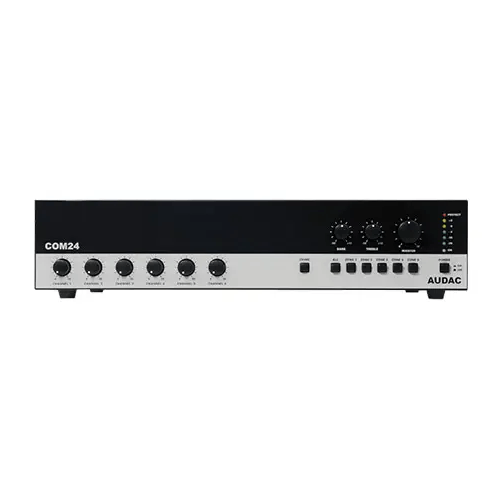

Audac COM12MK2 120W Public Address Amplifier
Regular Price:৳0.00Availability: SKU: 6.87.617.9645
Quick Overview
-
Support
Saturday – Thursday: 09 AM - 06 PM. -
Payment
Cash on Delivery | Card | Online Payment -
Shipping Cost
Inside Dhaka 100tk | Outside Dhaka 150tk -
Warranty Policy
Read More
Description
Audac COM12MK2 120W Public Address Amplifier in Bangladesh
The Audac COM12MK2 is a 120 W public address amplifier in a black finish, specified as a Class A/B model with a transformer power supply. The supplied specifications list balanced microphone/line inputs, an unbalanced stereo line input, priority-related functions and Euro terminal-block outputs. This combination gives system planners a number of connections and functions to evaluate for a PA installation. The product is identified as the UK version, with a listed mains input of 230–240 V AC at 50–60 Hz.
Rated power. The amplifier is specified at 120 W RMS/AES. Its output voltage and impedance are listed as “100 V / 4 Ω,” but the supplied information does not explain whether these are selectable output modes, how they map to the terminals or which system configurations they support. Check the product documentation and terminal labels before connecting speakers. Do not assume support for an unlisted output voltage or load, and do not select a connection solely from the amplifier’s 120 W rating.
Matching the speaker system. A PA amplifier must be matched to the connected speakers and the intended wiring arrangement. Before installation, confirm each speaker’s connection requirements and the amplifier’s supported output configuration. If the system uses multiple speakers, check the complete load and wiring against the amplifier documentation. The supplied specifications do not give a recommended speaker count or detailed wiring diagrams, so ask for clarification if you need a particular system arrangement.
Class A/B design and power supply. Class A/B is the listed amplification technology, and a transformer power supply is specified. These details can help when comparing amplifiers, but they do not by themselves establish power consumption, operating efficiency or suitability for a particular site. Consider the full installation requirements, including connected equipment, mains input and operating conditions. If a technical characteristic is important to your decision, check its measurement or configuration in the manufacturer’s documentation rather than inferring it from the technology name.
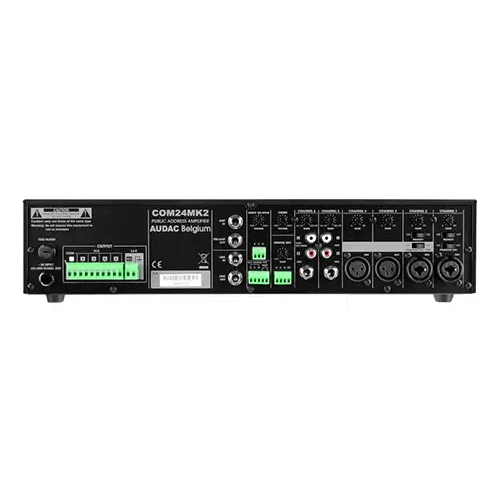
Balanced inputs 1–4. The first four balanced microphone/line inputs are listed with the notation “-6 dB / -50 dB.” Their connectors are specified as two XLR/Jack combo sockets and two XLR connectors. The supplied information does not explain the reference for those level figures or how each input is configured. Check the input instructions when choosing microphones, line sources and cables. Confirm which equipment connects to each socket and whether any channel-specific settings are required.
Balanced microphone/line input 5. A fifth balanced microphone/line input is listed with the same “-6 dB / -50 dB” notation. Its connector is a 6.3 mm jack. The supplied details do not state whether this input has the same phantom-power or priority functions as inputs 1–4. If you intend to use input 5 for a specific microphone or line source, verify its requirements and operating behaviour in the documentation for the exact unit.
Unbalanced stereo line input. The amplifier also has one unbalanced stereo line input with RCA connectors. The level notation supplied for this input is “+14 dB / -30 dB”; its reference and precise interpretation are not explained. Check the output level and connection type of your source equipment before connecting it. If your source is stereo, confirm how the amplifier handles the signal in the PA system rather than assuming an output-routing arrangement that is not described in the supplied specifications.
Phantom power. The input details list “4 × 15 V DC Phantom” in relation to the balanced microphone/line inputs 1–4. Verify which channels provide phantom power and how it is enabled before connecting microphones. Check the requirements of each microphone against the amplifier’s instructions; do not assume that every input provides phantom power or that every microphone should receive it. The supplied information does not specify phantom-power availability for input 5.
Priority-related functions. The listed additional features include a remote microphone described as “Priority mic + chime,” tele-paging described as “Priority line,” and a priority mute contact. These details may be relevant to a PA system that needs priority announcements or paging. The product information does not explain the trigger method, contact wiring, channel assignment or sequence of operation. If a particular paging or mute behaviour is essential, confirm how it is configured and what external equipment is required before purchase.
Output connectors. Two types of output connector are specified: a 2-pin Euro terminal block and a 10-pin Euro terminal block, both with a 5.08 mm pitch. The output voltage/impedance entry is “100 V / 4 Ω.” The supplied information does not state how the connectors correspond to that entry or provide pin assignments. Check the unit’s labels and the current wiring documentation before connecting speakers. Do not assume that all terminals carry the same output or that a particular connector serves a specific mode without confirmation.
Audio performance figures. The listed frequency response is 20 Hz to 20 kHz within ±3 dB. Signal-to-noise is specified as greater than 90 dB. THD+N is listed as less than 0.5% at 1 kHz, and crosstalk as greater than 70 dB at 1 kHz. Common-mode rejection ratio is specified as 70 dB. These values can help buyers compare the amplifier with other products. If a measurement is important to a project, check its test conditions and reference in the manufacturer’s documentation.
Protection features. The COM12MK2 lists DC, short-circuit, overheating and overload protection, along with signal limiting. These are useful product details to review when evaluating an amplifier for a fixed installation. They do not remove the need to match the speaker load, follow the wiring instructions or operate the amplifier as specified. The information supplied does not describe protection thresholds or responses, so consult the manual if a particular protection behaviour matters to your system.
Cooling and operating conditions. The amplifier is specified as convection cooled. Allow for the manufacturer’s recommended ventilation and clearance when choosing a rack or tabletop location, and avoid blocking airflow paths. The listed operating temperature is 0 °C to 40 °C at 95% humidity, although the supplied information does not explain the humidity measurement conditions. Check the installation environment against the full product guidance; this operating-condition entry is not an ingress-protection rating.
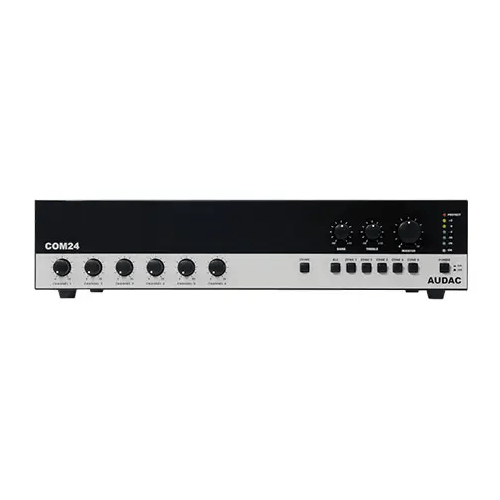
Rack and tabletop installation. The COM12MK2 is listed for 19-inch, 2 HE rack mounting or tabletop use, and a 19-inch rackmount adapter is included. Its dimensions are 420 × 88 × 320 mm (W × H × D), and its stated weight is 9.7 kg. Use these measurements when checking rack space, cabinet depth, support and access for cables. The product details identify the rackmount adapter but do not list every fixing or accessory that may be needed for an installation, so confirm the package contents.
UK version and mains input. The specified AC source is 230–240 V at 50–60 Hz, and the product is identified as the UK version. The supplied details do not identify the plug type or describe any voltage-selection procedure. Ask BME to confirm the mains connection and requirements for the exact unit, particularly if the amplifier is being installed in Bangladesh. Do not assume a particular plug, power cable or compatibility arrangement unless it is confirmed for the item being offered.
Possible PA uses. The COM12MK2 may be considered for a public address system that needs microphone and line-source inputs, with paging or priority functions evaluated as part of the design. Potential settings might include reception areas, meeting spaces, shops or other locations where a suitable PA system is required. These are examples for assessment, not guarantees of coverage or suitability. The connected speakers, output configuration, room or site layout and announcement requirements all affect the system design.
Planning announcements and paging. If the system needs a remote microphone with priority and chime, tele-paging or a priority mute contact, confirm how each feature is connected and operated. The specification names these functions but does not describe their setup or external requirements. Check the microphone, paging source, wiring and any control contacts against the product instructions. Do not assume a particular chime sequence, automatic priority behaviour or paging procedure unless the manufacturer’s documentation confirms it.
Planning inputs and sources. List the microphones and line-level devices the system will use, then compare their connectors with the amplifier’s XLR/Jack combo, XLR, 6.3 mm jack and RCA inputs. Confirm whether the signal level and input type suit each source. The supplied dB notations do not identify their reference, so clarify their meaning if you are preparing a detailed gain structure. This helps avoid relying on assumed signal levels or channel behaviour.
Purchase details to confirm. The supplied information does not state a warranty period, country of manufacture or package contents beyond the rackmount adapter. Ask BME to confirm details that affect your purchase, including the exact version, included items and applicable written terms. If delivery, installation or another service is important, ask whether it is available for your location and what conditions apply; do not assume it is included.
The Audac COM12MK2 is best assessed by matching its 120 W rating, listed output specification, inputs and priority functions to the requirements of the intended PA system. Its Class A/B design, performance figures, protection features, mounting options and mains input offer useful points for comparison. Confirm the terminal mapping, speaker configuration and UK-version power requirements before ordering so the amplifier fits the connected equipment and installation plan.
✅ Key Features
- 120 W rated output: The supplied specification lists 120 W RMS/AES power handling.
- Class A/B technology: Uses the amplification technology specified for this model.
- Balanced microphone/line inputs: Lists four inputs on XLR/Jack combo and XLR connectors, plus a fifth input on 6.3 mm jack.
- Stereo line input: Includes one unbalanced stereo input on RCA connectors.
- Priority-related functions: Lists remote mic with priority and chime, tele-paging priority line and a priority mute contact.
- Euro terminal-block outputs: Specifies 2-pin and 10-pin output connectors, both with 5.08 mm pitch.
- Protection features: Lists DC, short-circuit, overheating and overload protection, plus signal limiting.
- Rack or tabletop placement: Supports a listed 19-inch, 2 HE format or tabletop use.
- Convection cooled: The specified cooling method has no fan listed in the supplied details.
- UK version: Mains input is listed as 230–240 V AC, 50–60 Hz; confirm the exact unit’s connection requirements.
✅ Usage / Applications
- Public address systems: Evaluate it for a PA system with compatible speakers and confirmed output connections.
- Announcements: Check the microphone inputs and system design for voice-announcement workflows.
- Paging setups: Review the remote microphone, tele-paging and priority-mute functions against the required operation.
- Meeting spaces: Consider it where multiple audio sources need to be connected to a PA system.
- Reception or service areas: Assess whether its input arrangement and output configuration suit the site.
- Commercial installations: Match the amplifier’s listed ratings and connections to the project’s speaker system.
- Rack-based systems: Consider the 19-inch, 2 HE format where rack space and ventilation are suitable.
- Tabletop installations: Use tabletop placement only where the surface, access and ventilation meet the product requirements.
✅ Benefits of This Product?
- Multiple source connections: The listed balanced Mic/Line and stereo RCA inputs give buyers connection options to check.
- Priority features identified: The product details name remote-mic, chime, tele-paging and mute-contact functions.
- Installation flexibility: Both rack mounting and tabletop use are listed.
- Technical comparison data: Frequency response, signal-to-noise, THD+N and crosstalk figures are specified.
- Protection information: Several protection features are listed for evaluation during system selection.
- Cooling method stated: Convection cooling can be considered when planning placement and ventilation.
- Rack dimensions provided: The 2 HE format and physical dimensions help with equipment planning.
- Power requirements stated: The UK-version mains input is specified as 230–240 V AC, 50–60 Hz, subject to confirmation for the exact unit.
✅ Ideal For
The Audac COM12MK2 may suit organisations and integrators planning a public address system that needs a 120 W amplifier with several microphone/line inputs and a stereo line input. Its listed remote microphone, chime, tele-paging and priority-mute functions may also be relevant to announcement or paging workflows, provided their operation and connections are confirmed for the intended setup. The 19-inch, 2 HE rack format and tabletop option offer two listed placement approaches.
It is best considered by buyers who can verify the output configuration and speaker connections before installation. The supplied output entry reads “100 V / 4 Ω,” but does not explain terminal mapping or operating options. Confirm those details, the input-level references and phantom-power allocation in the product documentation. As the unit is identified as the UK version, verify its 230–240 V AC input and connection for the intended site.
✅ Why Choose the Audac COM12MK2 120W Public Address Amplifier?
The Audac COM12MK2 is worth considering when a PA installation needs an amplifier rated at 120 W RMS/AES and multiple input connections. The supplied details list four balanced microphone/line inputs, a fifth balanced microphone/line input and an unbalanced stereo RCA line input. This gives system planners useful information to compare with their microphones and source equipment. The model also lists a remote mic with priority and chime, tele-paging with priority line, and a priority mute contact.
For technical comparison, the specifications include a frequency response of 20 Hz–20 kHz, signal-to-noise greater than 90 dB, THD+N below 0.5% at 1 kHz and crosstalk greater than 70 dB at 1 kHz. The amplifier is Class A/B, convection cooled and lists DC, short-circuit, overheating and overload protection as well as signal limiting.
The 19-inch, 2 HE rack format, tabletop option and included rackmount adapter are practical details for planning an installation. At 420 × 88 × 320 mm and 9.7 kg, it is important to check available rack depth, support, cabling and ventilation.
Before choosing it, clarify the listed “100 V / 4 Ω” output specification and the terminal assignments. Verify input levels, phantom-power allocation, priority operation and the exact unit’s 230–240 V mains connection. The best choice is one whose confirmed configuration suits the speakers, sources and site.
✅ Why Buy This Product from BME?
When enquiring with BME about the Audac COM12MK2, provide details of the PA system you plan to use and ask for the current quotation. Confirm that the offered amplifier is the UK version and check its stated 230–240 V AC, 50–60 Hz input against your installation requirements. Ask about the power connection for the exact unit rather than assuming it from the product name.
The supplied output specification reads “100 V / 4 Ω,” but does not explain the terminal mapping or operating conditions. If your speaker system requires a particular output mode, ask for clarification before ordering. You can also verify microphone input assignments, phantom-power availability, priority functions, package contents and any applicable written warranty terms. The rackmount adapter is listed as included; other accessories are not specified.
If delivery, installation or another service matters to your purchase, ask whether it is available for your location and what terms apply. Do not assume that services or warranty coverage are included unless BME confirms them. Confirm the exact model and purchase conditions before placing an order.
✅ Buying Guide
- List the system requirements: Identify the microphones, line sources, speakers and paging controls you intend to connect.
- Match input connectors: Check your equipment against the listed XLR/Jack combo, XLR, 6.3 mm jack and RCA inputs.
- Clarify input levels: Ask how the supplied dB notations are referenced and configured.
- Verify phantom power: Confirm which inputs provide the listed 15 V DC phantom power and which microphones require it.
- Check priority functions: Confirm how the remote mic, chime, tele-paging and priority mute contact are connected and operated.
- Clarify the output: Verify the meaning of “100 V / 4 Ω,” terminal assignments and supported speaker configuration.
- Avoid unlisted assumptions: Do not assume 70 V operation or an output arrangement not confirmed by the product documentation.
- Confirm mains requirements: Check the exact UK-version unit’s 230–240 V AC connection and plug requirements.
- Plan the location: Allow for the 19-inch, 2 HE format, 420 × 88 × 320 mm dimensions, 9.7 kg weight and cable access.
- Allow ventilation: The amplifier is convection cooled; follow the manufacturer’s clearance guidance.
- Review operating conditions: Check the listed 0 °C–40 °C and 95% humidity condition against the site.
- Confirm purchase details: Ask BME about the exact unit, included items, written terms and any services you need.
✅ Customers Ask About / Frequently Asked Questions
-
Q: What is the Audac COM12MK2 price in Bangladesh?
A: Contact BME for the current quotation. -
Q: What is the amplifier’s rated power?
A: The supplied specification lists 120 W RMS/AES. -
Q: How many microphone/line inputs are listed?
A: Four balanced Mic/Line inputs are listed, plus a fifth balanced Mic/Line input. -
Q: What other audio input does it have?
A: One unbalanced stereo line input on RCA connectors is specified. -
Q: Does it support paging or priority functions?
A: The listing names a remote mic with priority and chime, tele-paging with priority line, and a priority mute contact. Confirm their operation and wiring. -
Q: What is the output configuration?
A: The supplied entry reads “100 V / 4 Ω.” Check the product documentation to confirm the output modes and terminal assignments. -
Q: Does it support a 70 V speaker system?
A: 70 V operation is not specified in the supplied details. Verify compatibility before purchase if your system requires it. -
Q: Can it be rack mounted?
A: Yes. It is listed for 19-inch, 2 HE mounting, with a rackmount adapter included. Tabletop use is also listed. -
Q: What mains input is specified for the UK version?
A: The supplied specification lists 230–240 V AC at 50–60 Hz. Confirm the connection requirements for the exact unit. -
Q: Where can I enquire about the COM12MK2 in Bangladesh?
A: Contact BME to confirm the current quotation and details of the exact amplifier.
✅ Why Buy This Product
The Audac COM12MK2 is a public address amplifier to consider when a system needs a 120 W rated unit with several balanced microphone/line inputs, a stereo RCA input and listed priority-related functions. Its 19-inch, 2 HE format, tabletop option and included rackmount adapter provide useful installation details. The listed protection features and audio-performance specifications can also help buyers compare it with other PA equipment.
Before ordering, check that the amplifier matches your speakers and intended wiring. The output specification is given as “100 V / 4 Ω,” so confirm its meaning and terminal assignments. Verify phantom-power allocation and priority operation if your setup depends on them. Since this is the UK version, confirm the exact mains connection and requirements for your location.
If its confirmed configuration suits your PA system, contact BME to check the exact unit and purchase details before completing your order.
What is the price of Audac COM12MK2 120W Public Address Amplifier in Bangladesh?
Write a review
Question Answer
Have question about this product? Get specific details about this product from expert.

TOA A-2030 Mixer Power Amplifier

TOA A-2060 Mixer Power Amplifier


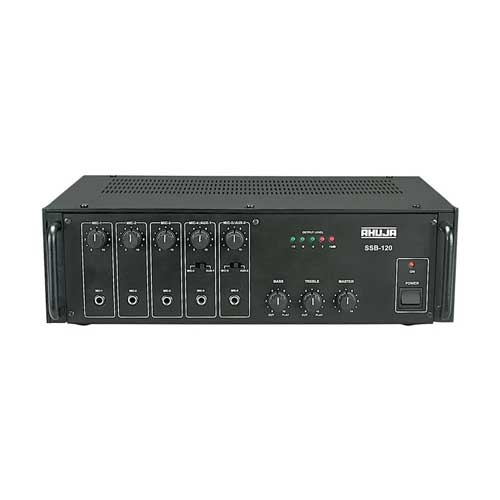
Ahuja SSB-120 120 Watts PA Mixer Amplifiers